
Operant Conditioning
Within the school of thought of Behaviourism, there are seen to be two strands of thinking around the learning and development of behaviours within an individual. These are Classical and operant conditioning.
Operant conditioning, or as it is also known as Instrumental conditioning, is a theory by behaviourist B.F. Skinner. Operant Conditioning views the development of development differently than that of classical conditioning. Within operant conditioning, behaviour learning is seen as an adaptive process in which learning and behaviour can be modified and programmed so that an individual is able to meet the desirable behaviour of their society, community, or immediate environment. One of the main differences between this theory and that of classical conditioning is thought the idea of how behaviour can be conditioned. As in classical conditioning, behaviour is an involuntary reflex to environmental stimulus, whereas operant conditioning sees behavioural responses as voluntary, conscious reactions to an experience or situation. One in which an individual chooses their reaction, and as such, this choice can be shaped, managed, and modified to the needs of the conditioner and environment.
Within Skinner’s theory, operant conditioning utilises a reward and punishment stimulus system to promote the conditioning of behavioural responses that are seen as desired and remove undesirable behavioural responses. The underlying idea within this reward and punishment system is that the individual would want to receive the reward and, as such, will portray the behavioural response that they know is wanted and will be rewarded and, as such, avoid punishment.
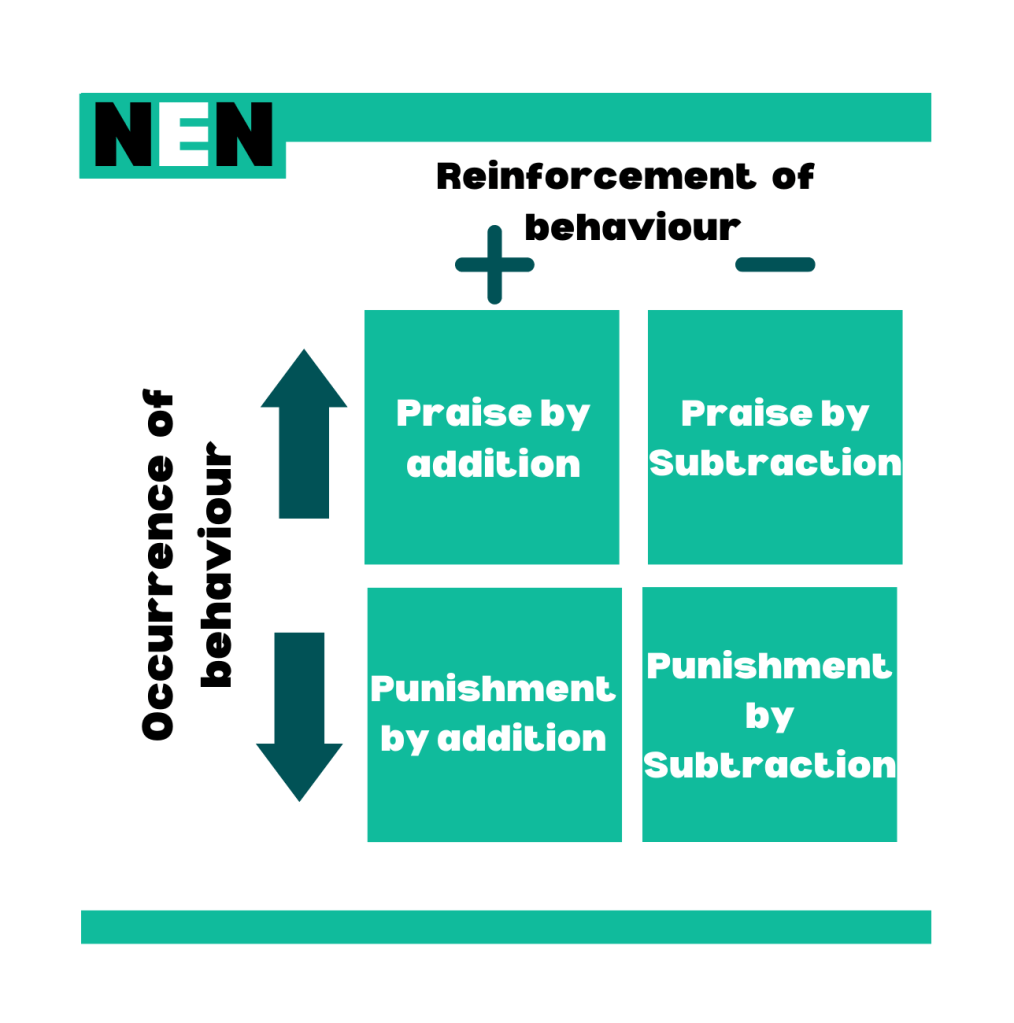
Operant conditioning’s reward and punishment system can be derived into four interconnected sections; Positive reinforcement, Negative reinforcement, positive punishment, and negative punishment.
The following two sections of this theory are designed to make the occurrence of wanted behavioural response increase as they focus on rewarding the individual for the correct response.
Positive reinforcement
Within this section, operant conditioning positive reinforcement focuses on the act or process of adding something deemed positive or wanted or rewarding the individual with a favourable outcome, event or item because they have demonstrated or shown behaviour that is seen as favourable or wanted.
This can simply be summarised as praise by addition.
Negative reinforcement
Within this section, operant conditioning negative reinforcement focuses on the removal of something that the individual sees as a negative outcome, event, or item. This is because they have demonstrated or shown behaviour that is seen as favourable or wanted.This positivity reinforces the wanted behaviour and, as such, makes the likelihood of it reoccurring again increase.
This can simply be summarised as praise by subtraction.
The following two sections of this theory are designed to make the occurrence of unwanted behavioural responses decrease as they focus on punishing the individual for the incorrect response.
Positive punishment
Within this section, operant conditioning focuses on the concept Skinner refers to as positive punishment. Positive punishment is the process of adding something deemed negative or unwanted to the individual with an unfavourable outcome, event, or item because they have demonstrated or shown behaviour that is seen as unfavourable or unwanted.
This can simply be summarised as punishment by addition.
Negative punishment
Within this section, operant conditioning focuses on the concept of negative punishment, which is the process of removing something that the individual sees as a positive outcome, event, or item. This is because they have demonstrated or shown behaviour that is seen as unfavourable or unwanted.
This can simply be summarised as punishment by subtraction.
A more in-depth look into this topic can be found here: NEN Explain: Operant Conditioning.
 Nottingham Education Network