

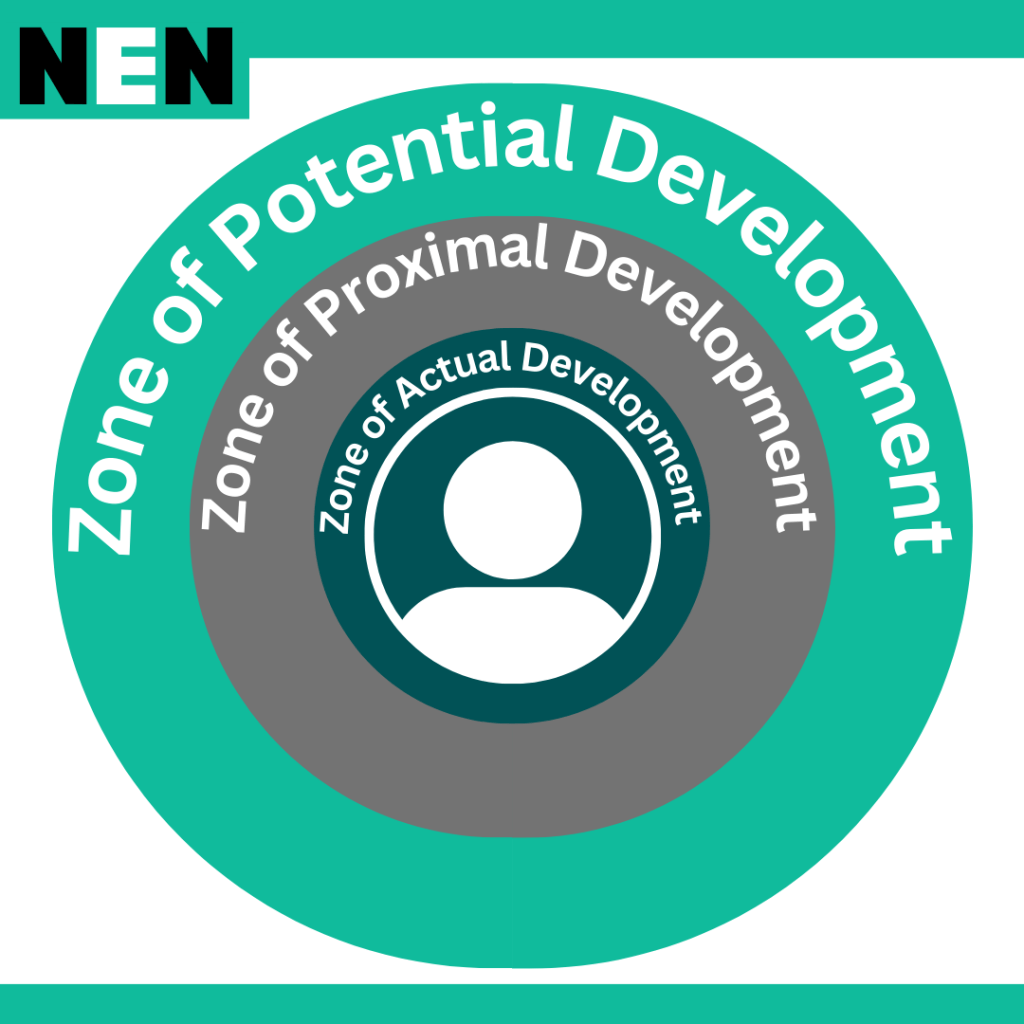
This theory can be split into three sections, or as Vygotsky would refer to them as, zones. Each zone focuses on an aspect of an individual’s level of development in regard to a specific knowledge, skill or behaviour. These categories can be referred to as the zone of actual, proximal and potential development.
The Zone of Actual Development
This zone focuses on knowledge, skills and behaviours that an individual has already developed and is able to recall, utilise and apply without the support, guidance or involvement of a more knowledgeable other. When an individual is in this the zone, it takes the involvement of the More Knowledgeable Other to support them into their Zone of Proximal Development to develop it further or master a new set of knowledge, skills or behaviours as this would be within the view of Vygotsky impossible for them to do so without support.
The Zone of Proximal Development
This zone focuses on the involvement and influence that social interaction and cultural understanding play in supporting the development and understanding of new or current knowledge, skills and behaviours within an individual.
Vygotsky himself describes the differences between the Zone of Actual Development and the Zone of Proximal Development as the following,
“The distance between the actual developmental level as determined by independent problem solving and the level of potential development as determined through problem-solving under adult guidance, or in collaboration with more capable peers” (Vygotsky, 1978, p. 86).
This means that all that is redividing knowledge, skills and behaviours from being in the zone of actual development to that of proximal development is the individual’s own ability to independently problem solve and understand the meaning behind them.
Within this zone, the More Knowledgeable Other supports the individual through a variety of ways. However, this is often referred to as scaffolded support or learning. This is guided and specifically tailored support for a less able individual to be able to complete a task. As the individual becomes more capable, the scaffolding is gradually removed.
The Zone of Potential Development
This zone focuses on knowledge, skills and behaviours that an individual would not be able to achieve even with scaffolded support from a more knowledgeable other. This is because it is beyond their current cognitive and or physical ability. However, as they gradually become more components in the zone of proximal development and it turns into their zone of actual development, this, in turn, turns into the zone of proximal development. This is due to the nature of the theory working in a spiral motion.
More Information around this theory can be found on the NEN Explain: The Zone of Proximal Development Theory page here.
 Nottingham Education Network