
Cognitive Load Theory is a psychological and instructional design theory that explains how the human brain processes information and how it can be used to improve learning and instruction. The theory suggests that the human brain has a limited working memory capacity, and when this capacity is exceeded, learning becomes difficult and ineffective. Therefore, in order to optimise learning, cognitive load theory recommends reducing extraneous load and optimising intrinsic load.
From the outset, cognitive load theory can seem to be complex and confusing. However, it can be divided into four pillars, representing the fundamental ideas underpinning the theory. These pillars provide a framework for understanding how cognitive load affects learning and how instructional design can be optimised to enhance learning outcomes. These are:
- Architecture: The cognitive architecture of human memory
- Biology: Biologically primary and secondary information
- Categorisation: Categorisation of intrinsic and extraneous load
- Domains: Domain-general versus domain-specific knowledge
The overarching idea of cognitive load theory which these fundamental ideas represent when connected, is in order to increase learning. You must reduce extraneous load and also optimise intrinsic load.
So, to understand what this means, let’s break down each of the pillars, starting with architecture and the workings of human memory.
Architecture: The cognitive architecture of human memory
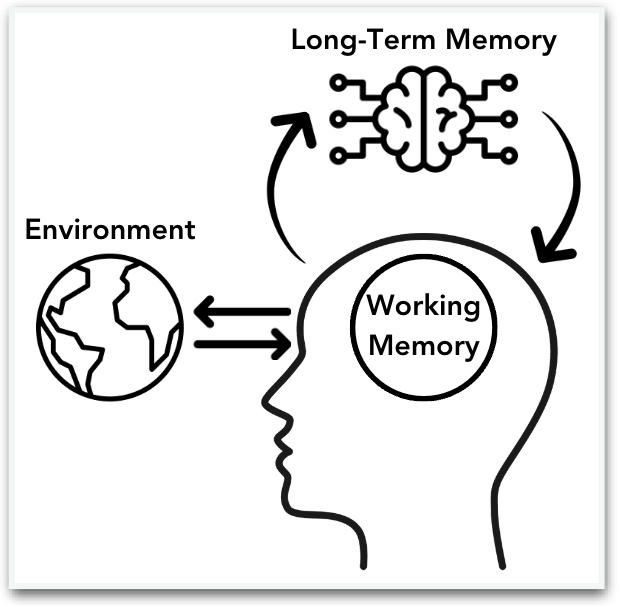
This pillar refers to the way human memory is structured and how information is processed in the brain. It suggests that human memory has a limited working memory capacity, and information can be transferred to long-term memory through repeated practice and meaningful connections. Within architecture, three components comprise the memory system: working memory, long-term memory and the environment.
Working memory
Working memory is different to the other two components that make up the memory system. This is because, unlike long-term and the environment, working memory has a limited capacity for information, whether new or recalled information.
Long-term memory
Long-term memory is the part of human memory responsible for storing information for a long time. Long-term memory is where information that has been rehearsed and connected to existing knowledge, such as life events, factual information, and procedural information, is stored. Long-term memory is seen as an unlimited internal storage, meaning there is no limit to what or the amount of information that can be stored, recalled and accessed.
The environment
The environment refers to information outside the mind, such as TV shows, books, newspapers and conversations. As expected, the environment is seen as an unlimited external store of information, meaning there is no limit to what or the amount of information that can be stored, recalled and accessed.
When using the different components together, it can be summarised simply as when developing new knowledge, an individual will reach out into the environment and bring new information into the working memory. This is where the brain begins to think about the new information and make connections to prior knowledge already stored within long-term memory, recalling it and then joining it together before sending it back to long-term memory.
Biology: Biologically primary and secondary information
This pillar refers to how the brain processes information and categorises it into biologically primary and secondary information.
Biologically, primary information is processed quickly, automatically and unconsciously while also being knowledge humans have evolved to acquire. The knowledge that fits into this category of information is that of speech and understanding, facial recognition and specifically emotional recognition while also covering socialisation skills and abilities and problem-solving.
Biologically secondary information requires more cognitive effort and attention, and as such, unlike primary information, it is a conscious effort. Biologically secondly, information is knowledge that humans have only relatively recently learned or become required to know.
Categorisation: Categorisation of intrinsic and extraneous load
This pillar refers to the way cognitive load can be categorised into intrinsic and extraneous load. Intrinsic cognitive load is the load resulting from the complexity or difficulty of the learning task, while extraneous cognitive load is linked to the manner, structure, and presentation formatting of the information that is to be learned but not the actual information itself. To summarise these two types, intrinsic is content over presentation, whereas extraneous load is presentation over content.
The following will illustrate the interaction between intrinsic and extraneous load within the working memory.

Here, we can see that the cognitive load has reached the capacity of the working memory, and the learner will not be able to retain any more information on the new or developed knowledge being presented to them.
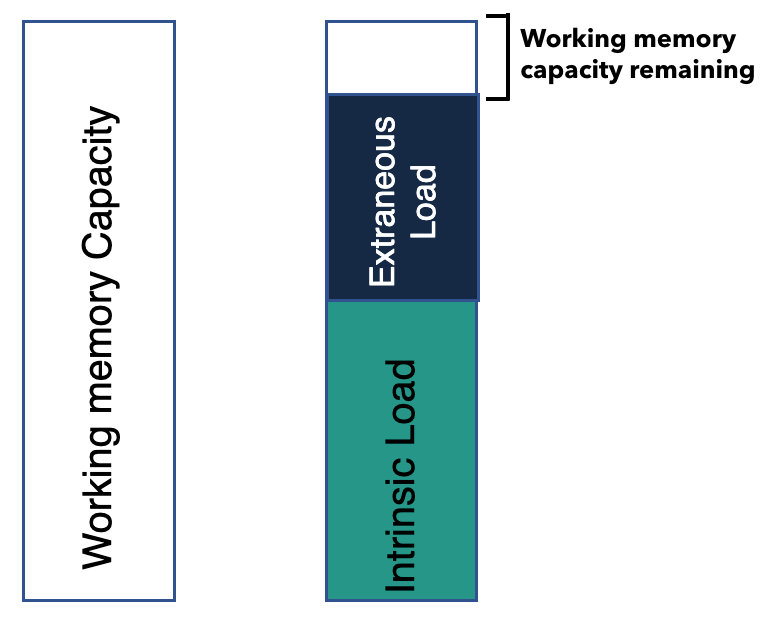
Here, we can see that the cognitive load and, by extension, the learner is not at capacity and, as such, not overwhelmed with the new or developed information as they have remaining working memory capacity.
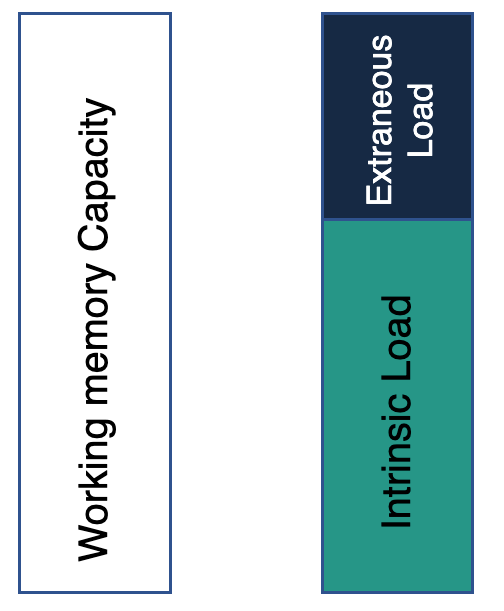
Here, we can see that the cognitive load has reached capacity, and the learner will not be able to retain any more information on the new or developed knowledge being presented to them. However, in this section, a large section of the working memory is taken up by extraneous load or the presentation of the information.
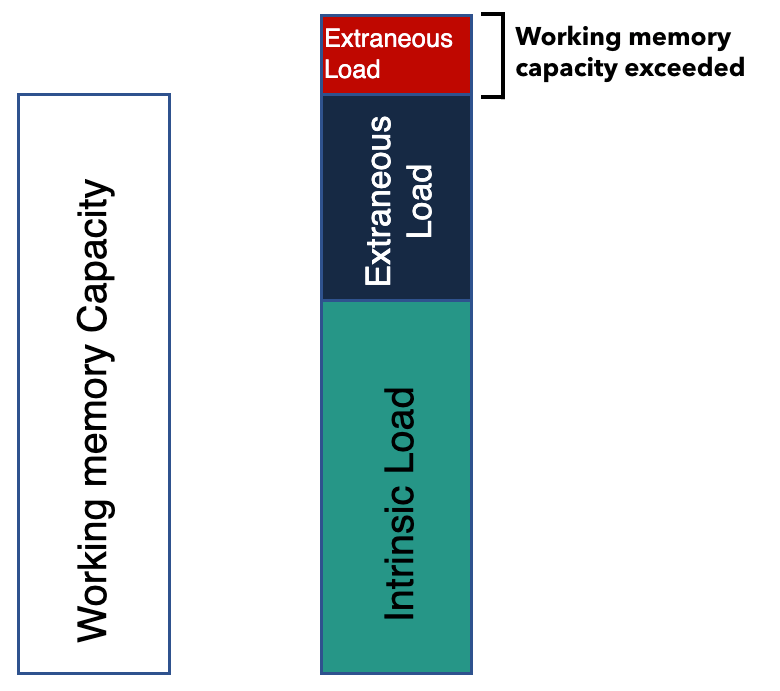
Here, we can see that the cognitive load has exceeded the working memory capacity, and the learner will become cognitively overloaded and will not be able to retain any more new or developed information being presented.
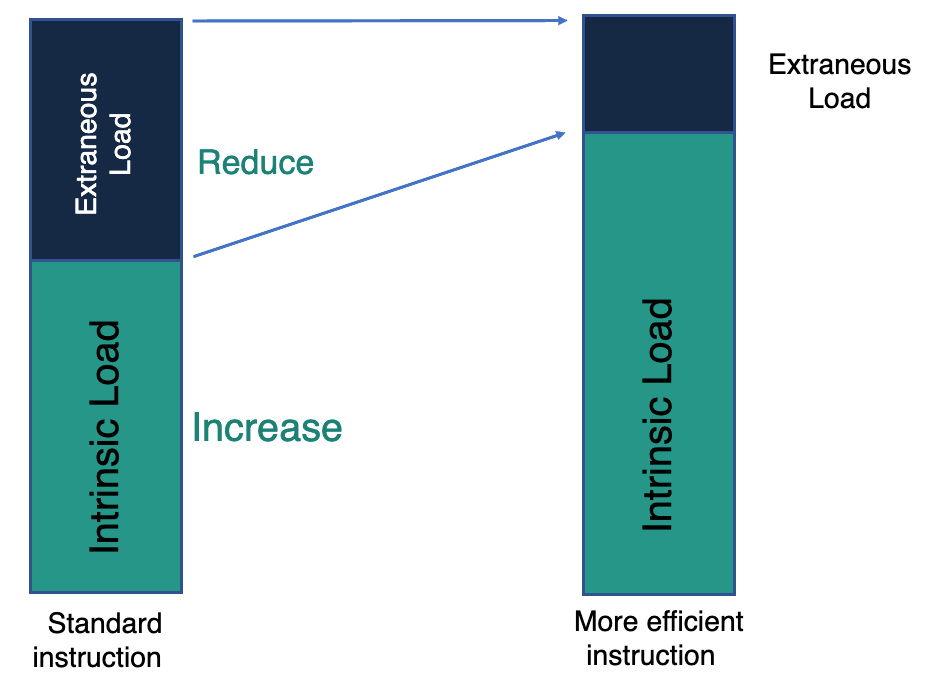
Finally, this illustrates the intentions of cognitive load theory and that of the categorisation of intrinsic and extraneous loads, the reduction of the extraneous load and the maximisation of the intrinsic load to enable more effective and efficient learning.
Domains: Domain-general versus domain-specific knowledge
This pillar refers to the way cognitive load can be categorised into domain-general and domain-specific knowledge. Domain-general knowledge refers to knowledge that can be applied to a wide range of situations and is considered to be a part of biologically primary knowledge, while domain-specific knowledge is specific to a particular domain or subject and is considered to be a part of biologically secondary knowledge.
 Nottingham Education Network