

About the theory
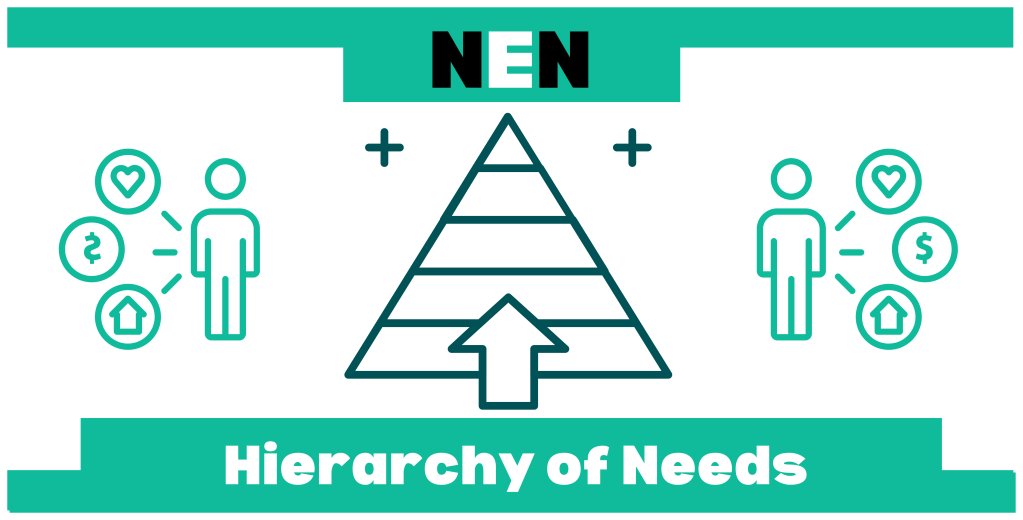
Maslow’s ‘Hierarchy of Needs’ is a theory in psychology that describes the five basic human needs that must be fulfilled for individuals to be motivated to reach their full potential. Maslow’s Hierarchy of Needs, sometimes referred to as a theory of motivation, is a classification system theorised to reflect the survival needs of individuals, then progressing to more acquired emotional needs. These needs are often depicted as a pyramid, with the most fundamental needs at the bottom and the most complex needs at the top.
Maslow’s theory explains how individuals are motivated to fulfil their needs. The theory proposes that basic physiological and safety needs must first be met before people can achieve higher-level needs such as belongingness, esteem, and self-actualisation. This theory has significant implications for education and training, as it highlights the importance of ensuring that learners’ basic needs are met so that they can fully engage in the learning process. This is because Maslow suggests that individuals won’t be able to achieve their full potential, engage in sessions or retain information unless their basic needs are met first. They are only focused on meeting the previous need and won’t be able to do anything else until that need is met. Maslow’s assertion on motivation and meeting needs is that, as one set of needs is met, the next level of needs becomes more of a motive. This is because a satisfied need is not a motivator. Only unsatisfied needs motivate an individual.
In the original theory, the hierarchy of needs can be divided into two sections. These are deficiency and growth needs.
Deficiency needs
Deficiency needs arise due to deprivation and are said to motivate people when they are unmet. Also, the motivation to fulfil such needs will become stronger the longer they are denied. For example, the longer a person goes without food, the more hungry they will become. However, once they are met, the motivation gained from them decreases.
Growth needs
Growth needs do not stem from a lack of something but rather from a desire to grow. Once these growth needs have been reasonably satisfied, one may reach the highest level of the Hierarchy of Needs.
An Exploration of the Needs
As mentioned, there are five needs within the original theory: physiological, safety, belonging, love, esteem, and self-actualisation.
Physiological
The first level of Maslow’s Hierarchy of Needs is the physiological needs. These basic needs are necessary for survival, such as food, water, and shelter. Without these needs being met, individuals cannot move on to fulfilling higher needs. Physiological needs are biological requirements for human survival. If these needs are not satisfied, the human body cannot function. Maslow considered physiological needs to be the most important as all the other needs become secondary until these needs are met.
According to Maslow’s hierarchy of needs, physiological needs are factored into internal motivation. This means that humans are compelled to satisfy physiological needs first. Once these have been met, the individual is motivated to pursue higher levels of intrinsic satisfaction.

Safety
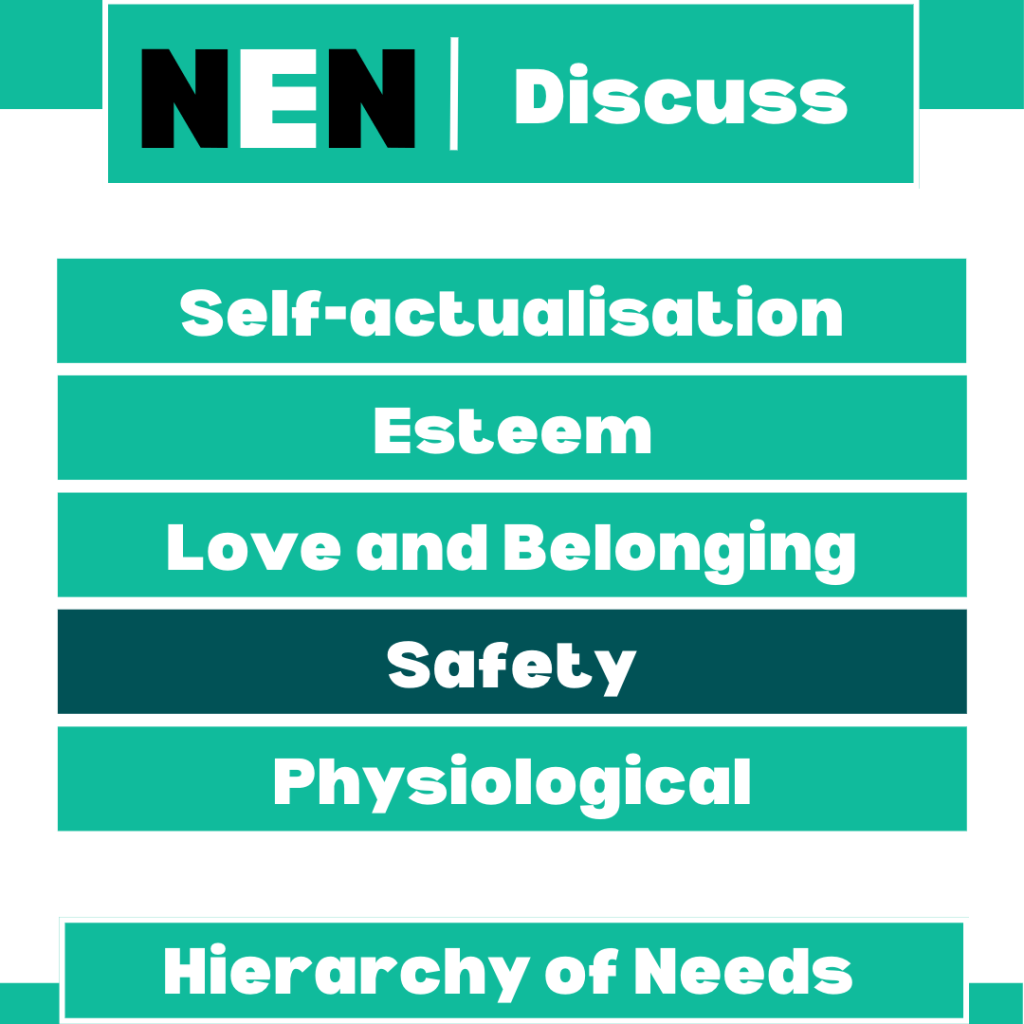
The second level is the safety needs. The need for security and safety becomes the next motivated desire. Finally, people want to experience order, predictability and control. These needs can be fulfilled by the family and society (e.g. police, schools, businesses and medical care). This can include physical safety, as well as financial and emotional security.
Love and Belonging
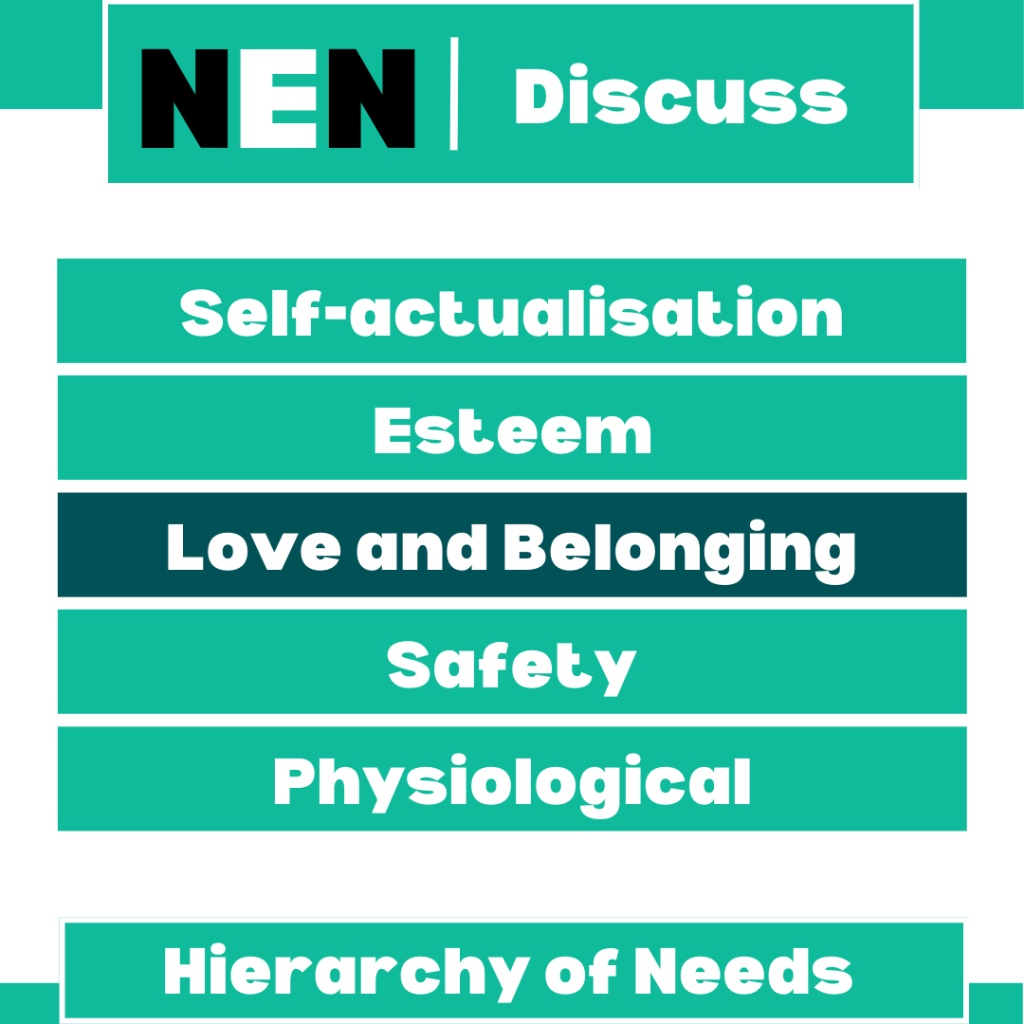
The third level is the need for belongingness and love. Belongingness refers to a human emotional need for interpersonal relationships, affiliating, connectedness, and being part of a group. Humans are social creatures and need to feel a sense of belonging to a group or community. This need can be fulfilled through family, friends, or other social groups.
Esteem
The fourth level is esteem needs. This includes the need for self-esteem and respect from others. Individuals need to feel a sense of accomplishment and recognition from others to fulfil this need. This can be achieved through achievements, recognition, and respect from others.
Maslow classified esteem needs into two categories, these being esteem for oneself, which covers dignity, achievement, mastery and independence. The other category of esteem is that of the desire for reputation or respect from others. This can be viewed as internal and external esteem.

Self-actualisation
The final level is the self-actualisation needs. This is the highest level of Maslow’s Hierarchy of Needs theory and includes the need for personal growth and fulfilment. Individuals must have met and continue to meet their lower needs before they can focus on self-actualisation, which can include pursuing goals, achieving personal growth, and realising one’s full potential. Maslow describes this level as the desire to accomplish everything possible and become the most possible.

What is meant by Self-actualisation?
When thinking about Self-actualisation, it is important to understand what it actually means by the term. Self-actualisation is used to describe the process of individuals realising their full potential and is characterised by a deep sense of fulfilment, purpose, and satisfaction.
At its core, self-actualisation is about becoming the best version of oneself. It is a process of personal growth and development that requires individuals to be introspective and reflective. This process involves identifying strengths and weaknesses, setting goals, and working towards achieving those goals. It also involves a willingness to take risks, explore new experiences, and challenge oneself.
Self-actualisation is not a destination or something to merely meet, like the other needs in Maslow’s theory but is instead a journey. It is an ongoing process of growth and development that requires individuals to constantly learn, adapt, and evolve. It is about realising one’s potential and living a meaningful, purposeful, and fulfilling life.
Individuals who are considered self-actualised are typically self-aware, have a strong sense of purpose and direction, and can form deep and meaningful relationships with others. They can also appreciate the beauty and complexity of the world and have a strong sense of morality and ethics. Although we are all, theoretically, capable of self-actualising, most of us will not become so, or only to a limited degree. Maslow (1970) estimated that only two per cent of people would reach the state of self-actualisation.
Maslow (1970) identified 15 characteristics an individual would require if they are, in Malsow’s belief, to have achieved their potential and self-actualised. These characteristics are;
- They perceive reality efficiently and can tolerate uncertainty
- Accept themselves and others for what they are
- Spontaneous in thought and action
- Problem-centred (not self-centred)
- Unusual sense of humour
- Able to look at life objectively
- Highly creative
- Resistant to enculturation but not purposely unconventional
- Concerned for the welfare of humanity
- Capable of deep appreciation of basic life experience
- Establish deep, satisfying interpersonal relationships with a few people
- Peak experiences
- Need for privacy
- Democratic attitudes
- Strong moral/ethical standards.
The Expanded Hierarchy of Needs
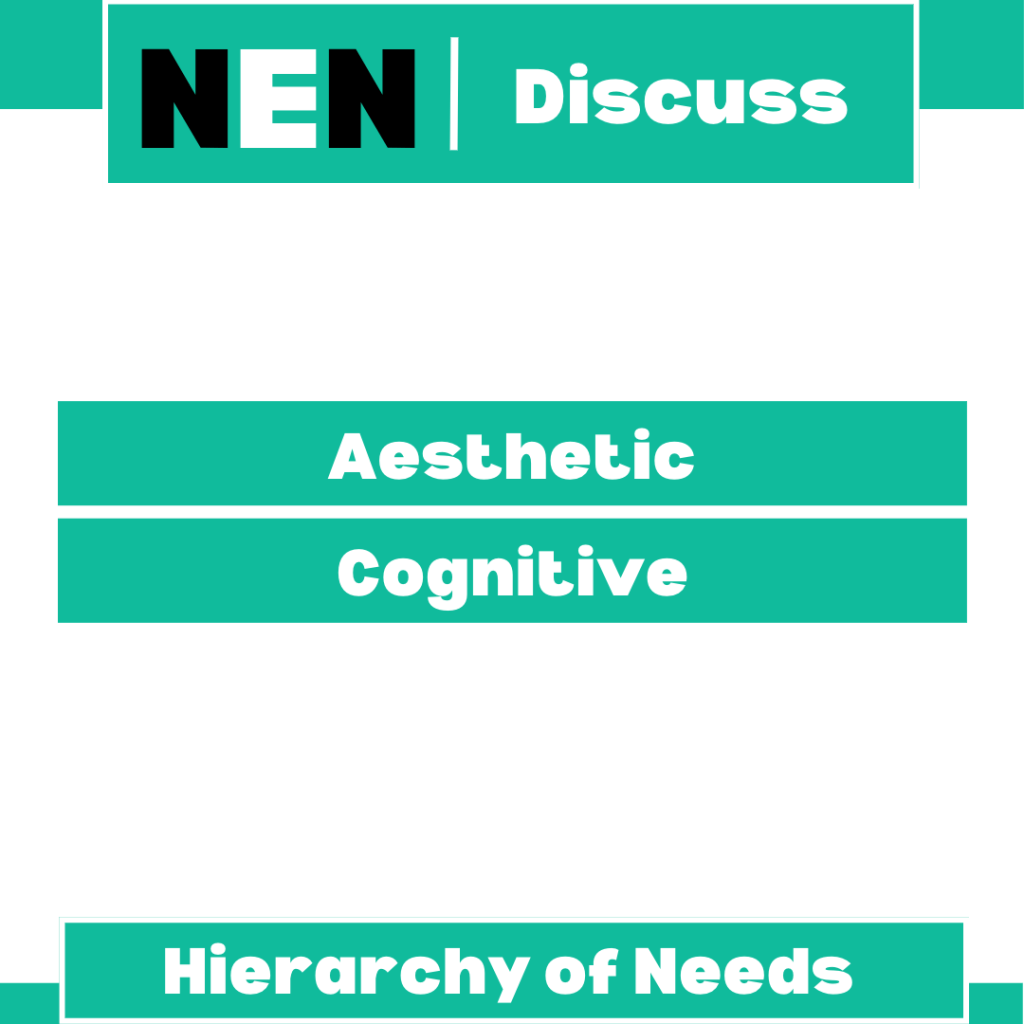
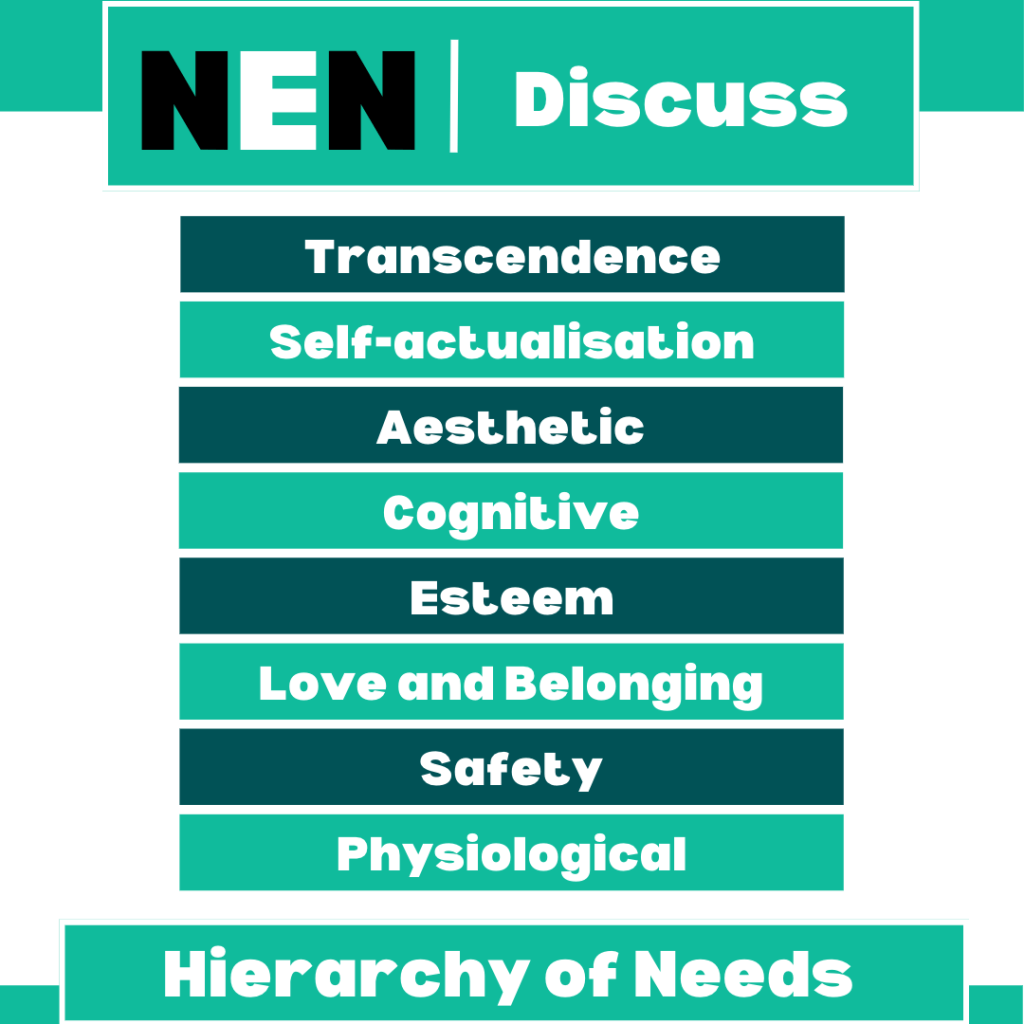
Initially, and as discussed, Maslow identified five basic needs in his theory; however, he later expanded this theory to include cognitive and aesthetic needs, which were crucial for personal growth and development. These two additions to the theory were included between esteem and self-actualisation.
Cognitive needs refer to the desire for meaning, information, and comprehension. This need includes curiosity, problem-solving, and creativity, and it focuses on an individual developing and having the will to learn and retain knowledge. Maslow believed that these needs were fundamental to human behaviour and that satisfying these needs would result in personal growth and development. These cognitive needs are often overlooked in many discussions of human behaviour, but Maslow highlighted their importance in his theory.
The Aesthetic needs, on the other hand, refer to the desire for beauty, balance and form. This need includes an appreciation of art, music, and nature and an appreciation for the beauty within the world around oneself on a day-to-day basis. This can be through natural or manmade experiences such as beautiful imagery or novel and aesthetically pleasing experiences. Maslow believed that the Aesthetic need was important for emotional development and well-being and that satisfying these needs can lead to a sense of fulfilment and happiness.
The inclusion of cognitive and aesthetic needs in Maslow’s Hierarchy of Needs theory was a significant development. It highlighted the importance of intellectual and emotional needs in human behaviour and provided a more comprehensive understanding of human motivation. These additional needs, like esteem, were included within the growth need category.
Transcendence
In addition to the other two additional needs, Maslow also includes a new ‘need’ at the top of the Hierarchy. This is the need, or to more acutely describe it, the concept of transcendence. Transcendence involves moving beyond one’s individual self and connecting with something greater. Due to this connection to something greater, transcendence is also often called Spiritual needs. This can take many forms, such as finding purpose and meaning in life, contributing to a larger cause, or experiencing a sense of fulfilment and satisfaction from being part of something bigger than oneself. Transcendence is seen as the ultimate goal of human development, and only a minority of individuals are believed to reach this level of self-actualisation.
While transcendence may seem a challenging and complex goal to achieve, it is considered a crucial aspect of personal growth and fulfilment. By striving to transcend one’s individual self and connect with a greater purpose, individuals can find a deeper sense of meaning and satisfaction in their lives. This can lead to increased happiness, improved mental health, and a greater sense of purpose and direction in life.
Self-actualisation and transcendence are the two highest levels of human needs. Self-actualisation refers to achieving an individual’s highest potential and fulfilling their unique purpose in life. At the same time, transcendence is about going beyond the individual self and connecting with something greater.
A completed view of Maslow’s Theory
Criticism of Maslow’s Theory
While Maslow’s Hierarchy of Needs theory has been widely accepted and used in various fields, it is not without its criticisms. There are several critiques of this theory that challenge its validity and applicability.
One of the main critiques of Maslow’s theory is that it is culturally biased and not applicable to all individuals and cultures. Maslow’s theory is based on the assumption that all human beings have the same needs and desires, regardless of their cultural background or upbringing. However, research has shown that cultural differences can significantly impact what individuals consider to be their basic needs and priorities. For example, in some cultures, the need for social connection and belonging may be more important than the need for self-actualisation, which contradicts Maslow’s hierarchy.
Another criticism of Maslow’s theory is that it is too simplistic and does not account for the complexity of human needs and motivations. The theory suggests that human beings have a clear hierarchy of needs that must be met in a specific order, but in reality, human needs are much more complex and interdependent. For example, an individual may need self-esteem, but their physiological or social environment may influence this need.
Furthermore, Maslow’s theory is criticised for being too individualistic and neglecting the impact of social and environmental factors on human needs and motivations. The theory focuses on the individual’s needs and desires but fails to address the external factors that may influence them, such as poverty, discrimination, and social inequality. In reality, social and environmental factors can significantly impact an individual’s ability to meet their basic needs and achieve self-actualisation.
Finally, Maslow’s theory is criticised for being too static and ignoring the dynamic nature of human needs and motivations. The theory suggests that human needs are fixed and unchanging, but human needs and motivations can change over time and in response to different circumstances. For example, an individual may have a need for safety and security during a period of economic instability, but this need may become less important during a period of prosperity.
 Nottingham Education Network
Leave a comment