
What is VARK?
To begin with, defining the term ‘learning styles’ seems appropriate as this will form part of the discussion around VARK. As suggested by Pashler et al. (2020), a learning style is a broad range of concepts, ideas and theories around an individual’s theoretically preferred mode of information devilry and the mode that enables learning to be the most effective for them. The term learning style, however, is more commonly used to loosely describe any attribute or characteristic of learning that an individual may hold, present or require. When viewed holistically, a learning style refers to all components that attribute, characteristics, needs or preferences that might affect an individual’s knowledge development, skills and behaviours.
As mentioned, this discussion will explore the learning style of VARK. However, over 70 different learning style classification systems could be selected and used to support the learning and development of individuals’ grasp of knowledge, skills and behaviours. That said, the VARK learning style by Neil Fleming is perhaps the most well-known, which divides and categorises four different modes of sensory information delivery preferences (Newton & Salvi, 2020). VARK’s approach within the Learning Style theory focuses on how individuals prefer information to be provided and presented to them and how they also prefer to deliver what they have learned.
Fleming introduced the theory in 1987 with the understanding and desire to support individuals to work independently in developing their knowledge, skills and behaviours and promote an awareness of the most effective learning style that suits their information delivery preferences.
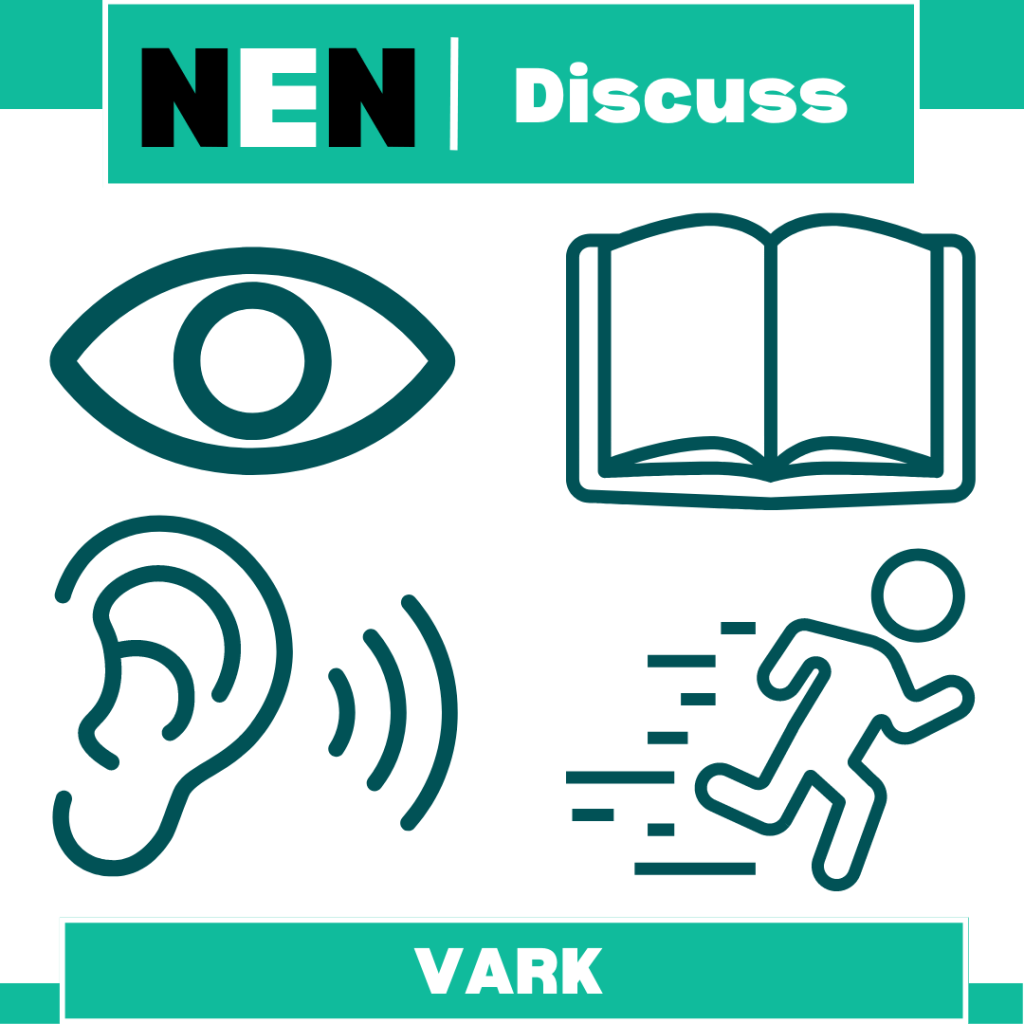
In the VARK model, information delivery is divided and categorised into four distinct sections. These are Visual, Auditory, Read-Write and Kinaesthetic. For an individual to be placed into one of these categories, they will be identified by whether they have a preference for:
- Visual learning
- Auditory learning
- Reading and writing
- Kinaesthetic learning
Unlike other Learning Style theories that have been theorised, VARK only focuses on an individual’s sensory information delivery preferences compared to other aspects relevant to learning, such as personality, motivation, socialisation, physical environments and methods of cognitive processing. Fleming did not exclude this as they were not deemed to influence learning but because VARK was only focusing on how modes of sensory information delivery impact the retention of knowledge, skills and behaviours within an individual, and that had the most direct application for more effective learning. It is also important to note that each of the different modes is equal in their influence on learning rather than being in a hierarchy or taxonomy of influence on the learning and developing knowledge, skills and behaviours. This is because they focus on an individual’s sensory information delivery preferences rather than the actual information provided or strategies that could be used to enhance learning.
What does each of the different elements of VARK represent?
Visual Learners
The first of the four sensory modes of information delivery is Visual. Visual learners are individuals for whom the sensory information delivery mode that best suits their learning and development of knowledge, skills and behaviours is that of seeing. Therefore methods such as graphic displays, including charts, diagrams, illustrations, handouts, videos, interactive whiteboards and graphic organisers, are the most suitable approaches for visual learners to understand the presented information.
A part of the information delivery approach of a visual learner is the body language and facial expression of the person presenting information, and this enables a visual learner to add the necessary broader context of what is being presented to them to support their understanding of the specific knowledge, skill or behaviour.
Simply displaying written text interestingly does not represent what visual learners are thought to require during the learning process. Instead, the information needs to be presented in pictorial format. This is because these individuals think in pictures and thus require pictorial formatted information to think about, retain and recall information.
Auditory Learners
The second of the four sensory modes of information delivery is Auditory or sometimes referred to as Aural. Auditory learners learn best by hearing information. This can be in the form of music, discussion, lectures, conversations and verbal explanations.
Auditory learners interpret the underlying meaning of speech by listening to the voice tone, pitch and speed of the presented information. Like visual learners, this broader informational context enables them to understand more effectively what is being provided about specific knowledge, skills and behaviours.
They rely on external monologue provided by themselves or others rather than their internal monologue when processing information being presented or has already been presented to them. This supported the processing, storing and conceptualising the knowledge, skills and behaviours.
Reading and Writing Learners
The third of the four sensory modes of information delivery is Reading and Writing. Reading and Writing learners prefer to take in information that is displayed as words and text as well as repeat the information back in the same format. This modality is linked to repetition. Individuals within Reading and Written will often copy what has been read or previously recorded to support the processing, storing and conceptualising of the knowledge, skills and behaviours. Methods often used to support individuals with this mode can be making lists, reading textbooks, and taking notes.
Kinaesthetic Learners
The fourth sensory mode of information delivery is Kinaesthetic. Kinaesthetic, or as it is also referred to, tactile links to learners that learn best through touch, manipulation and practical activities.
A fundamental aspect of this sensory mode of information delivery is hands-on experience. Hands-on experience is essential for kinaesthetic learners with a “trial and error” approach to their learning. This approach enables them to process and conceptualise the information that is being processed to them. In addition, directly manipulating objects and materials enables them to understand specific knowledge, skills and behaviours better.
Methods that support Kinaesthetic or tactile learners can be in the form of movement, experiments and hands-on activities.
What are some criticisms of VARK?
Between 2000-2015 there was a range of reviews, studies and papers which explored the validity of learning styles and, more specifically, that of VARK. They found that there was little to no evidence to support the idea that matching the sensory mode of information delivery to the Learning Style of individuals supported their learning and development of knowledge, skills and behaviours.
This growing body of research has concluded that learning styles do not positively impact student learning in classroom instruction. However, Learning styles, specifically VARK, still form part of creating a differentiated learning approach for individuals. This is despite the contrary being accurate and that using VARk and focusing on one mode of the sensory delivery can, as critics have suggested, become a barrier to learning and developing knowledge, skills and behaviours.
Contradictory to the evidence and research that has been and is being produced, there is still a long-held view that individuals have different learning styles and that educators should be effective teachers adapting their teaching, learning and learning assessment to these. The continuing popularity of VARk is evident when almost 90 per cent of educators from an international study have stated that they believe in the efficacy of learning styles and the VARk system and regally use it within their planning, delivery and assessment of knowledge, skills and behaviours. Again, this is despite Rogowsky and colleagues (2015) identifying no relationship between a learner’s supposed learning style within VARK and their actual level and capabilities.
However, with this being stated, the understanding and thought that goes into understanding individuals learning, even within the restrictive perspectives of the sensory mode of information delivery, can be used to support the learning and reinforce knowledge, skills and behaviours if used with a range of more effective strategies as this can be used to develop a more contextualised understanding of the individuals learning needs. Following on from this As well as this, focusing on the VARK modes of sensory information delivery alongside other methods and strategies allows for both individuals and educators to have the opportunity to adjust their practices to personalise learning and teaching of knowledge, skills and behaviours to their individual needs.
As existing research has found that matching and the identification of supposed individual Learning Styles does not influence their academic and educational attainment, it also appears to have little to no influence on how an individual chooses to study. This is because the results of a VARK assessment often do not correlate with the preferred teaching and learning methods selected, used and benefitted from, as seen within the work of Newton & Salvi (2020).
Another criticism of the VARK method concerns the proposed, perceived pigeonholing and subsequent demotivation of being allocated to a specific VARK sensory mode of information delivery. Impacting their internal thought process and understanding of what they can and cannot do and what they might be good at. This could lead to them avoiding certain activities and topics because the knowledge, skills and behaviours will not be presented, provided or displayed in their VARK mode. However, Newton & Salvi (2020) suggest that there is evidence that individuals hold consistent preferences for how they receive information but strongly suggest that these preferences do not connect or correlate with the individual’s knowledge, skills and behaviours.
A potential theoretical criticism of VARK could be that Dual Coding is a more effective method of informational delivery than that of a single-mode system such as VARK. However, multimodal is an idea that has been incorporated into the VARK learning style about understanding the effectiveness of dual coding and the awareness of individuals holding more than one preference. However, VARK differs because it suggests that the requirement for a multimodal approach is limited to a small number of individuals rather than in dual coding, where all benefit from and require this approach.
However, with that being said, it is acknowledged that there are few instances where only one mode is used or sufficient for developing knowledge, skills and behaviours. Because of this, when an individual completes the VARK test, they are given a score for all four modes. Identifying their main preferences and other modes that might be beneficial for different areas of study and individuals not provided with a mean preference are categorised within the VARK system as being multimodal. Alternatively, if there are two dominant preferences, they will be categorised within the VARk system as Transitional.
 Nottingham Education Network
Leave a comment