
What is the Zone of Proximal Development theory?
One of the foundational theories of Social Constructivism is that of Lev Vygotsky’s work on the Zone of Proximal Development. The Zone of Proximal Development focuses on the implications, influence, and involvement of social interaction in an individual’s learning and the role another person plays in supporting the development of an individual through guidance and instruction. Vygotsky, unlike Piaget, saw natural, spontaneous development as part of but not the primary driver of learning. He believed that an individual would not develop to their full potential if they were only provided with an opportunity to discover their own knowledge, skills and behaviours and instead required the support of others.
Due to this, within his theory, Vygotsky describes how an individual would move through and interact with knowledge, skills and behaviours. He referred to the role of a More Knowledgeable Other and specifically that of the level of involvement they provided. For example, within his theory, Vygotsky posits that as individuals gain competence within the specific knowledge, skill or behaviour they are attempting to develop, the more knowledgeable others will simultaneously reduce and withdraw the support they provide.
The More Knowledgeable Other is, within this theory, a term used by Vygotsky to refer to an individual who, depending on the task, activity or event, is further along in their development than that of the person to whom they are supporting. When thinking about the more knowledgeable other, it is important to understand that this role doesn’t rely on age but on experience and level of ability and development within whatever knowledge, skill or behaviour is required for the task, activity or event the other person is undertaking. As such, the More Knowledgeable Other role is shared within an educational setting between children, peers, and educators.
One reason that the More Knowledge Others is a vital aspect within this social model of learning is, as Vygotsky argued, that involvement and interaction with another person and through the use of dialogue and language is an important aid to learning.
The term’ zone of proximal development’ represents the distance between what an individual is capable of doing unsupported and what they can only do when supported by a More Knowledgeable Other. Therefore, the term ‘proximal’ refers to the knowledge, skills and behaviours an individual is close to achieving. Proximal meaning close.
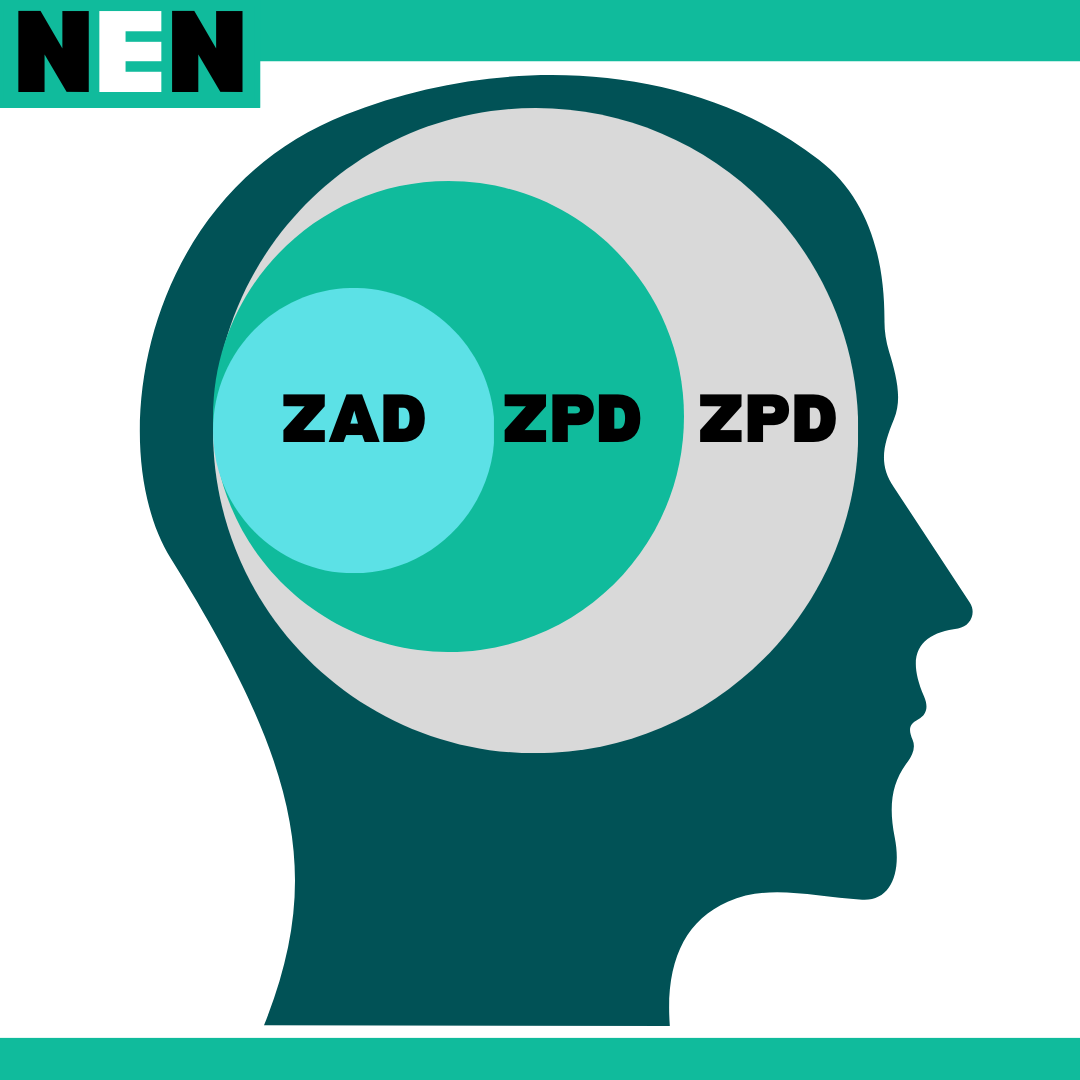
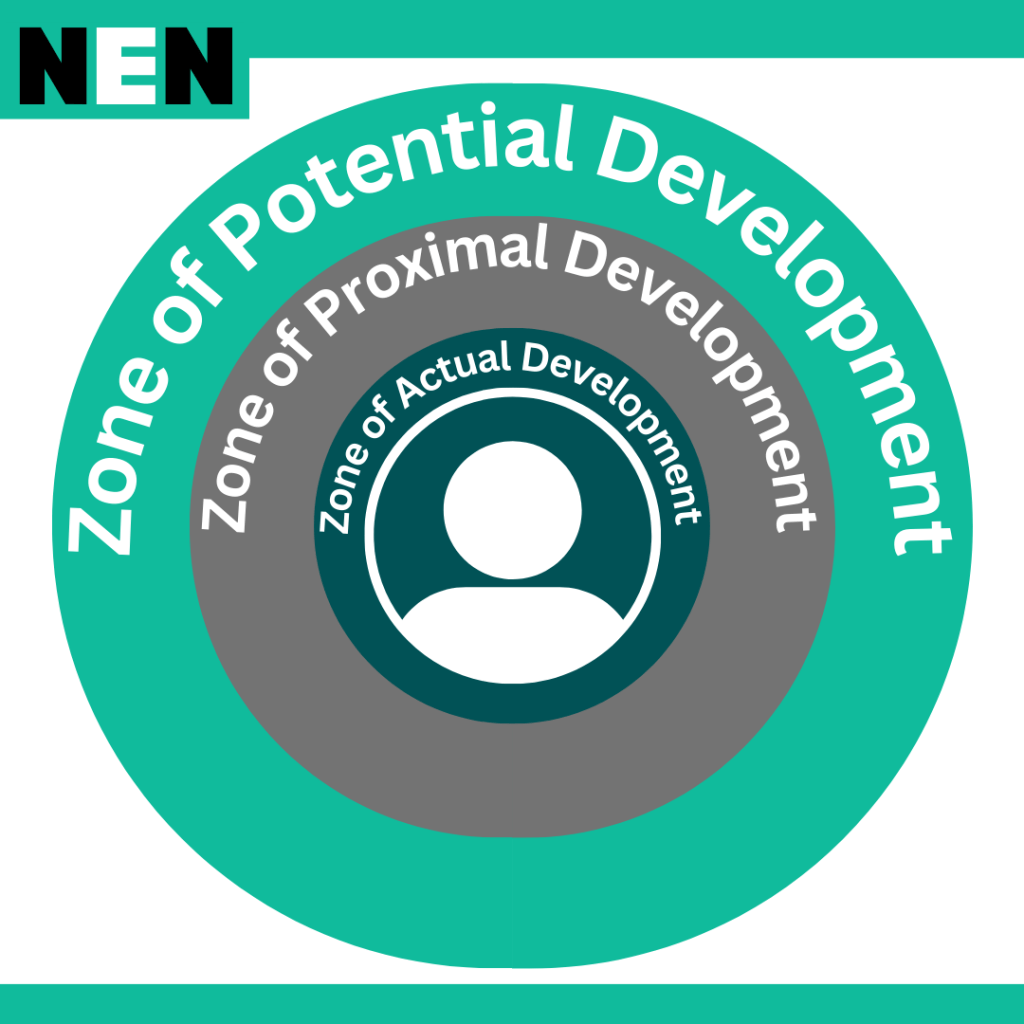
This theory can be split into three sections, or as Vygotsky would refer to them, zones. Each zone focuses on an aspect of an individual’s level of development regarding a specific knowledge, skill or behaviour. These categories are referred to as the zone of actual, proximal and potential development.
The Zone of Actual Development
This zone focuses on knowledge, skills and behaviours that an individual has already developed and is able to recall, utilise and apply without the support, guidance or involvement of a More Knowledgeable Other. When an individual is in this zone, it takes the involvement of the More Knowledgeable Other to support them in their Zone of Proximal Development to develop it further or master a new set of knowledge, skills, or behaviours. As this would be within the view of Vygotsky, it is impossible for them to do so without support.
The Zone of Proximal Development
This zone focuses on the involvement and influences that social interaction and cultural understanding play in supporting the development and understanding of new or current knowledge, skills and behaviours within an individual.
Vygotsky himself describes the differences between the Zone of Actual Development and the Zone of Proximal Development as the following,
“The distance between the actual developmental level as determined by independent problem solving and the level of potential development as determined through problem-solving under adult guidance, or in collaboration with more capable peers” (Vygotsky, 1978, p. 86).
This means that all that is redividing knowledge, skills, and behaviours from being in the zone of actual development to that of proximal development is the individual’s ability to problem solve and understand the meaning behind them independently.
Within this zone, the More Knowledgeable Other supports the individual through a variety of ways. However, this is often referred to as scaffolded support or learning. This is guided and specifically tailored support for a less able individual to complete a task. As the individual becomes more capable, the scaffolding is gradually removed.
The Zone of Potential Development
This zone focuses on knowledge, skills and behaviours that an individual would not be able to achieve even with scaffolded support from a more knowledgeable other. This is because it is beyond their current cognitive and or physical ability. However, as they gradually become more components in the zone of proximal development and it turns into their zone of actual development, this zone, in turn, turns into the zone of proximal development. This is due to the nature of the theory working in a spiral motion.
Cultural understanding
The relevance of this theory is still talked about in many ways. For example, one of the ways that the Zone of Proximal Development still influences current educational practice is by highlighting the role that one’s own culture can impact in understanding, shaping and developing knowledge, skills and behaviours. Vygotsky believed that by promoting cultural capital, an individual could build knowledge, skills and behaviours more effectively. This has been reflected within current practice, as Ofsted (2019) has included the term in the current Education Inspection Framework. Much like Vygotsky, Ofsted views cultural understanding as the essential knowledge children need to prepare them for their future within education, the workforce and, more broadly, the wider world. This is because it enables an individual to apply meaning and context to the knowledge, skills and behaviours that they are either being presented with or attempting to develop, as well as shaping the individual understanding as to the implications and application of this knowledge, skills and behaviours based on what is seen as values, appropriate as well as invaluable and inappropriate.
The More Knowledgeable Other provides the individual with the cultural capital to apply meaning to the activity, event or experience and the knowledge, skills and behaviours to interpret and understand the activities, events or experiences. This can mean that since the Education Inspection Framework has reintroduced the idea of cultural capital back into the psyche of educational practitioners, it has enhanced the quality and opportunity of children and young people to work within their Zone of Proximal Development and make meaningful development in their knowledge, skills and behaviours as the cultural meaning and context can be more effectively applied.
It is also important to remember that Vygotsky was developing his thinking relatively soon after the Communist revolution in Russia. As such, his work is influenced by the communist and Marxist ideas of social and cultural understanding and importance when shaping people’s minds, beliefs and opinions.
The natural rate of development
An aspect of this theory that caused some contention was the connection that Vygotsky places on maturational thinking and its implications on learning and development. Vygotsky identified that individuals have a natural process for acquiring and constructing knowledge, skills and behaviours that can only be supported and guided to a certain extent. Where the contention can arise is that Vygotsky began to argue against the idea that individuals have a biological limit to their cognitive and intellectual development. For example, an individual’s current level of knowledge, skills, and behaviours are developed from, in part, their upbringing, social interaction, and communication. This is where Vygotsky suggests that if that individual is underperforming, then it is not an issue with them. Still, with the quality and quantity of their upbringing, social interaction and communication, as such, can be remedied, which at the time was the opposite of what other Constructivist theorists were stating, such as Piaget (Sutton,2000).
Starting with natural development, Vygotsky believed that there is an optimal age for all learning to occur and that for some knowledge, skills and behaviours, individuals can either be too young or too old to efficiently develop and gain them. This is somewhat reminiscent of that of Piaget’s work, where he supports this constructivist viewpoint on learning through his Stages of Cognitive Development theory. This is where Piaget states the processes and rate of the development of knowledge, skills, and behaviours within young children at specific age ranges. It is rigid in his view that individuals cannot enhance their progress through these stages of cognitive development with extra support.
Language and the Zone of Proximal Development
Verbal communication is a crucial aspect of this theory. Without it, Vygotsky believed that an individual would be unable or find it challenging to get into their zone of proximal development. One reason was that Vygotsky saw language as a tool supporting the development of new and existing knowledge, skills and behaviour. This stems from learning being a social event and that learning would not occur without socialisation. With this socialisation also came the indistinguishable aspect of language and, more specifically, that of spoken conversation. Effective instruction was the name Vygotsky provided for communication, a tool to support development. Effective instruction was a method and vessel for sharing ideas, thoughts, options and views bi-directionally between the individual and the more knowledgeable other. This, in turn, enabled the individual to more easily develop and shape their understanding of specific knowledge, skill or behaviour they are focusing on.
This practice of verbal and non-verbal communication has been an area of particular strength within the early years of England for many years. However, since the Early Years Foundation Stage inspection, language and communication and broader interaction have been quintessential aspects of how practitioners interact and support children’s development. From the questions they ask, the answers they provide and the conversation they extend. Each adds value, understanding and insight into the lives of the children they are educating.
Reference
Vygotsky, L. S,. 1978. Mind in Society: The Development of Higher Psychological Processes. Massachusetts: Harvard University Press.
Ofsted,. 2019. The Education Inspection Framework. London: Ofsted https://feweek.co.uk/wp-content/uploads/2019/05/Education_inspection_framework.pdf
Sutton, A,. 2000. Would the real Vygotskii please stand up. England: Teaching Times. Available at: https://www.teachingtimes.com/vygotskii-ttc1/
 Nottingham Education Network
Leave a comment