

What is the plan?
Under Sunak’s plans it will be made mandatory for all pupils in England to study maths to the age of 18. Currently Pupils can stop study Maths after GCSE at 16 years old.
This plan has been stated as the maths teaching being provided through different routes, rather than through A-levels maths.
As this is a new plan not much detail has been provided by the Government, Prime Minter or Department for Education. They have stated that they will be working on this plan more formally from now.
Why this plan?
This plan aims to tackle innumeracy and better equip pupils for the modern workplace as he sets out his priorities for the year ahead. One of the reasons given for this is that currently only around half of 16-19 year-olds study any maths at all, and the problem is particularly chronic for disadvantaged pupils, 60% of whom do not have basic maths skills at age 16.
This is also supported by about 8 million adults in England have the numeracy skills of primary schoolchildren, according to government figures.
The Prime Minter further justified this plan by stating “In a world where data is everywhere and statistics underpin every job, our children’s jobs will require more analytical skills than ever before and letting our children out into the world without those skills, is letting our children down”.
What do other countries do?
Currently unlike the UK (England, Scotland, Wales, and Northern Ireland) many developed countries including Canada, Germany, Finland, Japan and the US require all their pupils to undertake maths to be studies until the age of 18. The UK is an outlier in allowing their pupils to opt out of maths at the age of 16.
Criticism to the plan
The Association of School and College Leaders said there was a “chronic national shortage of maths teachers”.
Teacher recruitment issues are not isolated to the UK. A recent Financial Times (link in the notes section) analysis found that more than 80,000 teaching positions remain unfilled in Germany, Hungary, Poland, Austria and France.
Almost half of secondary schools are using non-specialist teachers for maths lessons, new research suggests (Martin, 2022).
Experts have warned that teacher shortages and the mitigations schools are forced to put in place to combat them – including the use of non-specialist teachers in certain subjects – “may be acting as a drag on system-wide improvement of pupil outcomes” (Martin, 2022).
This is “likely to have a negative impact on longer-term skill development and supply, particularly in Stem [science, technology, engineering, and maths subjects, and ultimately on long-term economic growth”, according to the study, conducted by the National Foundation for Educational Research (NFER) and funded by the Nuffield Foundation.
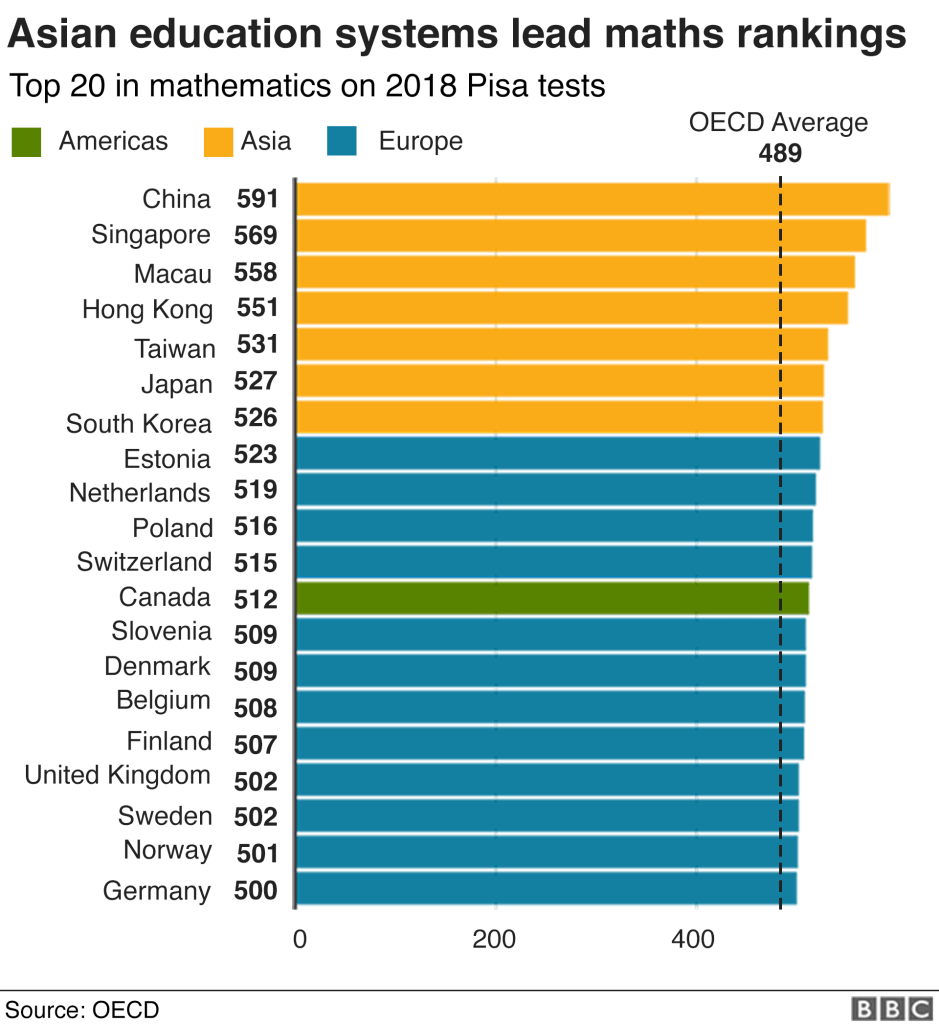
This stance of low achievement is again countered by the OECD which compares the UK to International results.
In the last round of PISA (Programme for International Student Assessment) tests in 2018, Fifteen-year-old students in the United Kingdom scored above the OECD averages in all core subjects reading (504 score points), mathematics (502), and science (505).
 Nottingham Education Network
Leave a comment